When Sofia moved from Greece to Switzerland at 23, she was building a life from scratch — a career, friendships, a future. Her family was far away in Athens, reachable only by phone. For years, that felt manageable.
But three years after settling in, Sofia’s mother was diagnosed with stage 3 metastatic breast cancer. “It was hard to cope,” Sofia said. “The implications and the possibilities — everything felt overwhelming.”
Then, in 2021, came what Sofia describes as a second hit: her maternal grandmother was diagnosed with stage 3 ovarian cancer.
Throughout this time, Sofia was living and working in Switzerland, while her mother and grandmother were in Greece. The distance made caregiving even harder. She could not always join medical appointments or hear information first-hand.
At first, Sofia believed the treatments were going well. But in 2023, she received the news that the cancer had spread to her mother’s bones. The once-active woman who looked after her, cooked for her, and brought her to school began walking with difficulty and, later, became unable to walk.
Sofia started travelling frequently back and forth between Greece and Switzerland, trying to help her family, understand the medical situation, and seek second, even third opinions.
But there was more to carry than medical updates. There were decisions, conversations, and painful questions with no clear answers.
Caregiving took its toll, not only mentally but physically.
“In the last weeks and months, while my mother was still alive, I lost a lot of weight caring for her. And many people say you have to take care of yourself to take care of the other patient, but at the moment, it’s very hard to focus on that because your whole attention is on your loved one,” she said.
When caregiving ends, and grief begins
Sofia began to sense that the end was near when doctors looked at the latest PET scans and told her that “sometimes things don’t work out.”
For so long, caregiving had meant action: booking flights, seeking opinions, asking questions, helping with daily needs, trying to understand what could still be done. Then, after her mother died, that urgency disappeared overnight.
“You’re just sitting there helpless, where you have done so much effort as a caregiver, you know, being in action, and then you realise there is nothing more you can do.”
What followed was not relief, but silence.
“One day I was waking up thinking, ‘What can I do today to help?’ And the next day, there was nothing. Just a very dark, silent space.”
Grief brought brain fog, exhaustion, and confusion. Even simple instructions became difficult to process. “I remember when my mom passed, the nurse came after to tell me what I have to do. I asked her 3 or 4 times to repeat herself. In the days that followed, her mother’s presence was still everywhere — in the house, in her belongings, even in her scent — and yet she was gone.
“Maybe I smell my mother still in the house or there are her things, but she’s not present here. I needed to understand what was happening to me, both physically and emotionally.”
That need to understand, and to find a way through, led Sofia to look for support when she returned to Switzerland. Six months after her mother died, her grandmother — who had been living with ovarian cancer since 2021 — also passed away. Grief was now carrying two losses at once.”
Finding Cancer Support Switzerland
Searching online, Sofia came across Cancer Support Switzerland. What drew her in was the bereavement support she spotted on the website — an Online Grief Workshop for people going through grief.
‘I didn’t want support that treated grief in isolation,’ she explains. ‘I wanted to speak to people who truly understand what cancer does — to patients, caregivers, and families.’
She filled in the form and someone from the team called her back. During that first, emotional conversation, they gently suggested something different: one-to-one counselling in Zurich. Sofia said yes, and a few weeks later, the sessions began.

“It became a space where I could finally stop holding everything in. In daily life, I was trying to function, but counselling was a space for me to dedicate this time to myself and to the emotions that I was feeling.”
Learning to live with grief, not move on from it

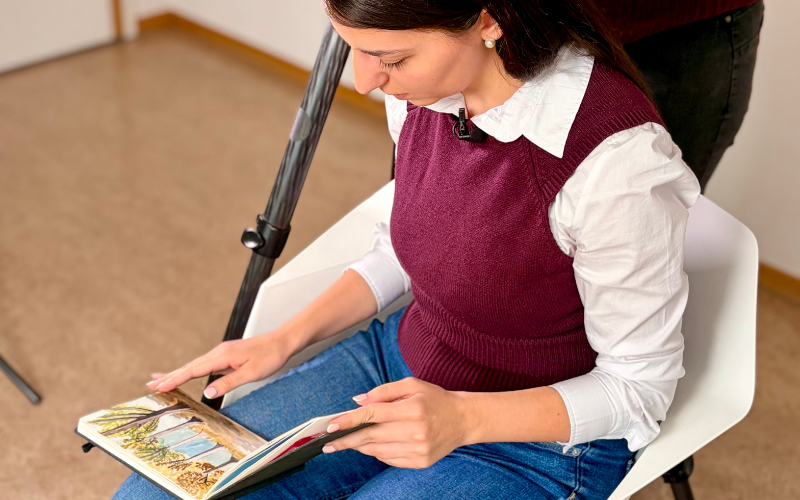
One unexpected and powerful part of the process was creativity. Her counsellor offered her a choice: write a poem about her grief or paint it. Sofia chose to paint.
Her first painting was a dark cave.
“I explained that this is how I feel right now, that I’m in a very dark place where my grief is and everything else outside is very sunny and very beautiful with flowers.”
“Throughout the counselling process, I was drawing a picture every time, and I could see the progress of understanding grief. So, the cave started to become a bit lighter with lighter colours.” Then, eventually, the cave disappeared. “
“And at the end of the process, there was no cave, because I realised that the grief is actually inside me. I carry it with me. And wherever I go, there is a part of grief, but I have learned how to manage it and I have learned how to live with that.”
Alongside counselling, Cancer Support Switzerland also posted Sofia two books on grief to her home in Lucerne, and she joined an Online Grief Workshop. Connecting with others who had lost loved ones to cancer helped her feel less alone.
“There’s huge power in peer support,” she added. “You realise your experience is shared. It was also beautiful to share stories of my mom and grandma and know that their memory lives on.”
“No one should face cancer alone”
Looking back, Sofia wishes she had known about Cancer Support Switzerland earlier, during her caregiving journey.
“It would have changed how I coped,” she says. “No one should face cancer, or caregiving alone.”
Her message to others is simple — and it comes from lived experience, not from a place of having all the answers:
‘If you’re caring for someone with cancer, or if you’re grieving, reach out. There are people who understand. There is a community that wants to support you. You don’t have to do this alone.'”